Showing posts with label blogging. Show all posts

Wednesday, January 27, 2016

"I'm stumped - what should I blog about?"

e-Communication students have occasional required blog posts of various types that we think are important to assist in learning or demonstrate learning of e-Comm material.  However, to really have an interesting and well-rounded blog, you may want to also include other kinds of posts.


"What could I possibly blog about that would be interesting to others?"


Oh - about a hundred things.  Seriously.  In these two posts, a girl, obsessed lists many possible blogging ideas. If you're stuck on figuring out what to write - scan through these and chances are you'll be back writing great posts in no time:

Oh - and, by the waaaay... one category in this year's eMagine competition is for blogs. 

(Also see our To-Do List For a Better Blog.)


Friday, January 8, 2016

Blog of the Week -- January 8

Visit www.smalltalkwithcorbin.com
The blog of the week belongs to Mr. Corbin Eaton, a junior in the video focus.  Corey has a flair for writing in a humorous, casual style – and for incorporating strong photographs into his posts.

Corey has decided to jump over to the Weebly platform, and combine his blog and portfolio there. (Juniors and seniors in all focus areas are now permitted to use other platforms than Blogger – ask your teacher which platforms will work best for your focus area.)

Great job, Corey!


Monday, November 30, 2015

Make a Bio page!

Pages?  We don't need no stinking pages!

Badges?
We don't need no stinking badges!
(Name that movie.)  Well, yes, we do need pages. So far on Blogger, you've been primarily making use of posts. Posts are the most common way to update a blog. They appear on your home blog page, and with time they get pushed down and off the main page by more current posts. Pages are more of a static entity. They stay put, and they are accessible by name from a menu on your site. You can put as much or as little on a page as you like - and you can add to them or edit them over time.

We will make a page for your Bio information, along with a handy link to it near the top of your blog.


Make a PAGE
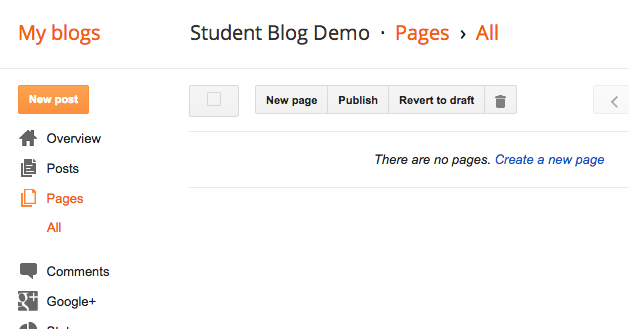

In your design menu, go to Pages, and then press the New page button at the top.


Name your page - About Me and Bio are typical names for this. You can always rename it later.

(This example was for something different.)


Add in the Content


Edit the page the same way you have been editing posts. This time, you need a photo (a semi professional one), a paragraph of bio info (you don't need as much as this example), and then your elevator pitch. (If you did not write your elevator pitch yet, the instructions are here.)

You only need 1 paragraph of bio info.
Instead of Skills, copy&paste your elevator pitch in here!


When finished, press the Publish button.

And... nothing happens.

That's because pages aren't blog posts - they come up by choosing them from a menu, as opposed to being displayed sequentially on your home page. So...

Add the Pages Gadget:


Now you need to go to your Gadgets in the layout menu, and scroll down to find the Pages gadget. Click the plus to add it.


This Pages gadget is basically a Pages Menu gadget.

Page names are on the left, and will only appear in the menu if you have their boxes checked.

Once the pages are checked, you may reorder them on the right side.  By convention, you should either place the Home page first or last.

(Yours will be Bio or About Me, instead of Graphics.)

Press Save when finished.


You may either position your Pages menu in one of the sidebar gadget spots, or...


... in a gadget at the top, in which case it looks like either a menu bar or tabs.


If your gadget doesn't show up, try moving it to a different location.


Test out the link in your gadget to make sure it is working.

Revisit your page now and then to keep it updated!


Here's another quick reference from Blogger on some of the details of pages and the pages gadget that were not covered above: Blogger Buzz

Friday, March 13, 2015

e-Comm Student Blog of the Week

About Me, Bio – whatever you want to call it –
your blog should have one! This is a great example.
This week's Blog Of the Week belongs to Josh Riess (Web Focus, Junior).

Josh's blog stands out for its classy, professional, and clean design - especially evident on his About Me page.

Does your blog have an About Me page yet?

Congrats, Josh!


Wednesday, December 17, 2014

What makes a good blog post?

As your e-Comm teachers have gotten used to blogging and having students blog, we've also been analyzing, discussing and refining what we think are the elements of a good blog post.

Tips from the blogosphere

This is not new ground, of course. Over in the right sidebar, you'll find links to sites that have specific tips for blogging. So far, they are:
Let us know when you happen upon more helpful sites that we should list!

e-Communication's big three

Your e-Comm teachers have decided to evaluate your blog posts on three main things. We'll also be teaching each of these things more intentionally next semester:
  • Content
  • Writing Style (Voice)
  • Presentation

Content:

This will vary, depending on the type of blog post you are doing -- from blogging about a current event to describing the process behind one of your projects. You will be informed of the expectations for each, as they come up. For example, if your blog post was about one of your projects, your content should successfully communicate the extent of the project, how it was done, what was learned, reflection and conclusions. You should also make links to relevant sites, and include graphics and video where appropriate.  If you don't have meaningful content, there's no point in anyone reading what you have to say!

Writing Style (voice):

Grammar and spelling matter. (Blogger has a spell-checker!) Use appropriate vocabulary (jargon or industry terminology appropriate to your focus area). Some of our posts in e-Comm will be rather technical. Others will be more abstract. So, the tone you take in your posts may depend a little on the nature of the content, and also on the preferences of your current teachers. But, by and large, your post should not read like a classroom assignment. Speak to your audience as a budding “creative” sharing your experience. “Blogging style” is a balance between conversational and professional. It isn't strict technical writing or research paper writing -- but, it isn't as casual as writing a letter to a friend. It's professional, yet engaging and personal enough to draw your reader in. 

Presentation:

Presentation is how your blog post looks. Use headings and sub-headings. Write your ideas in concise paragraphs, and include multi-media and links as evidence, appropriately placed and formatted. The typeface, size, and color of text should combine to make your text easy to read. Remember the design principles of CARP -- Contrast, Alignment, Repetition, Proximity (grouping). A great presentation is not only attractive -- it also makes your content easier to read and understand.

Content + Writing Style + Presentation

When you convey good content in an effective writing style and a well-designed presentation, you've created the perfect storm - a combustible mixture of elements that elevate your blogging to a new level. Your posts will earn higher grades, but much more importantly, your followers will want to read what you have to say, and you'll be honing those communication skills that will serve you well in your future endeavors!